
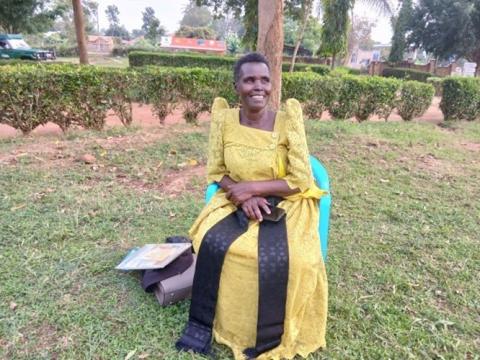
Mbabazi with joy narrates her story having engaged with TOPOWA.
When women are equipped with leadership skills and provided with safe spaces for civic engagement, they become powerful agents of change in their communities. This is clearly demonstrated in the story of Hon. Mbabazi Veronica, a 56-year-old woman councilor representing Puti-Puti and Boliso One Sub-County in Pallisa District Council.
Hon. Mbabazi attributes her transformation into a confident, credible, and effective leader to the TOPOWA Conversations implemented under the SCEPA Project. Her engagement with the project began in October 2024, when she joined TOPOWA through her community platform (Mother-to-Mother Women’s Group). As a group leader, she actively participated in structured TOPOWA community conversations, which strengthened her capacities in leadership, accountability, human rights advocacy, and community mobilization.
Through the TOPOWA convening approach, Hon. Mbabazi gained practical skills and confidence to facilitate meaningful dialogue among women on people-centered service delivery. While she had prior experience as a community leader, she acknowledges that TOPOWA significantly deepened her understanding of inclusive leadership and citizen engagement areas in which her capacity had previously been limited.
As a result of strengthened leadership and collective action, the women’s group transitioned from being passive service beneficiaries to active rights holders and duty bearers. Under Hon. Mbabazi’ leadership, women began engaging constructively with local health centre management and the Sub-County Technical Planning (STP) structures to demand improved maternal health services. This sustained engagement led to measurable changes, including improved attitudes of health workers toward women seeking care and increased accountability reflected in more consistent attendance of health workers at the facility.
Leveraging her dual role as a community leader and elected councilor, Hon. Mbabazi effectively amplified women’s priorities at the Sub-County Technical Planning Committee (STPC) and health facility levels. With strong community backing, she successfully advocated for practical service delivery improvements, including; provision of a water dispenser in FY 2024/25, ensuring access to safe drinking water for expectant mothers; and introduction of meals for expectant mothers attending antenatal services, improving attendance and overall maternal well-being.
Although modest in scale, these interventions have had a significant positive impact on the dignity, comfort, and health-seeking behavior of expectant mothers. The services are now fully operational and are directly benefiting women in Puti-Puti and Boliso One Sub-County.
This outcome demonstrated that the TOPOWA convening approach is an effective, scalable, and cost-efficient model for strengthening women’s leadership, enhancing citizen accountability, and improving service delivery in underserved communities. By empowering women to identify local challenges and implement locally driven solutions, the SCEPA Project is contributing to sustainable and inclusive community transformation.